In-Depth
Casio’s 2019 shipment ranking put the round DW-6900, launched in February 1995, first in Japan, ahead of the square DW-5600, and the 6900 is still in today’s catalogue.
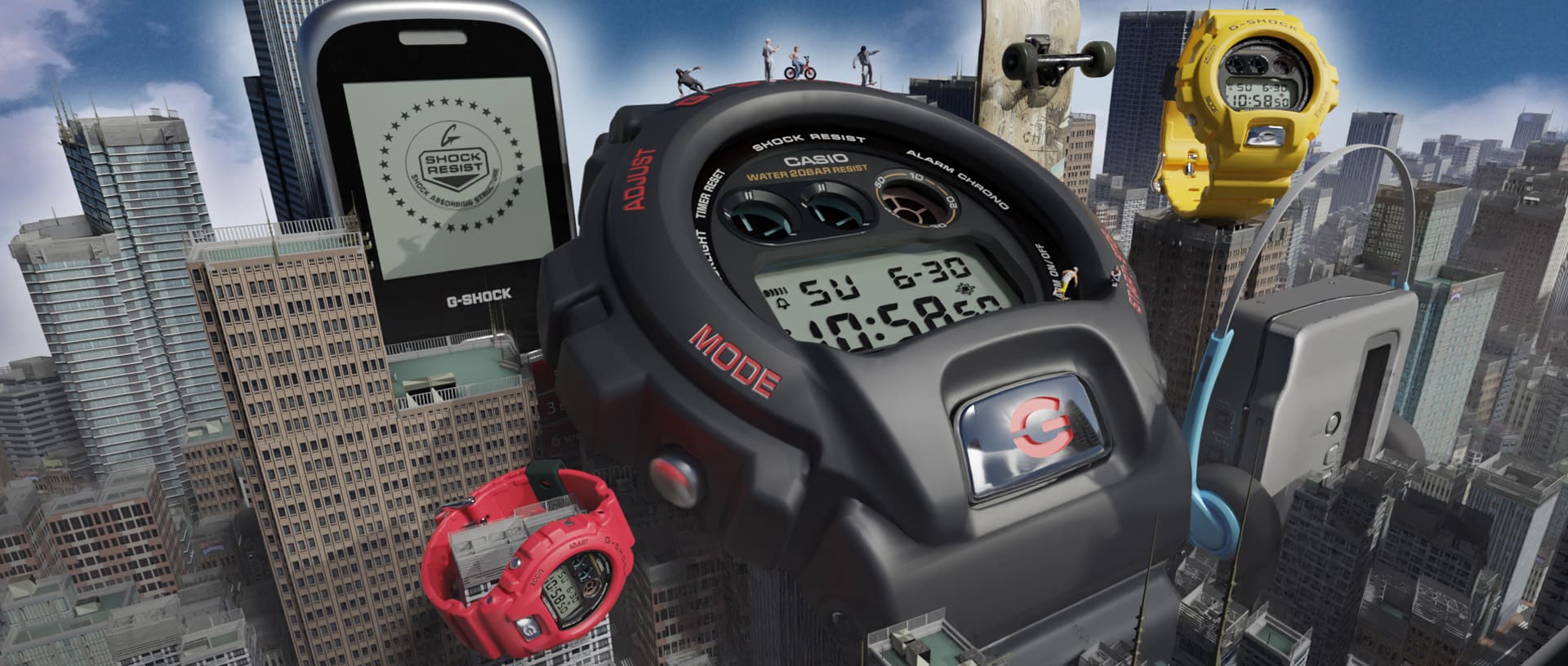
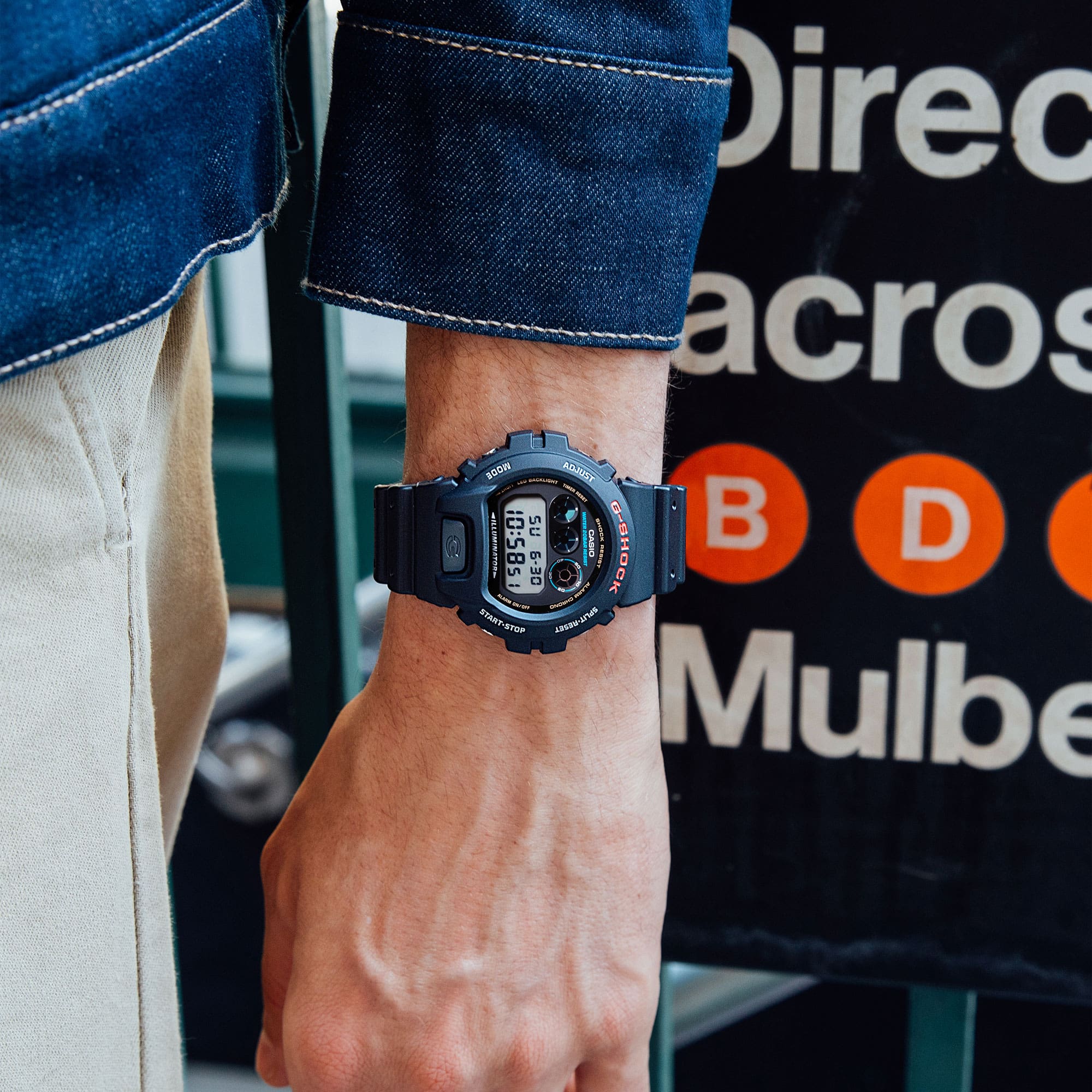
The G-Shock story usually starts with a square. The DW-5000C of 1983 set the template, and its direct descendant, the DW-5600, is still in production. Yet when Casio published its all-time shipment rankings in February 2019, the G-Shock at the top of the Japanese list wasn’t square at all. It was the DW-6900, a round resin watch with three circular graphics above the display and an oversized light button below it.
Worldwide, the DW-6900 came third, behind the GA-110 and the GA-100. In Japan it led the DW-5600 and the GA-110. Casio counted units shipped and grouped colour variations under their base model, so a version such as the DW-6900MR added to the total, while a separately numbered model such as the DW-6935C did not.
A quartz watch in a resin case went on to equip skateboarders and US Navy divers, carry Eminem’s name and end up dressed in 14k gold and diamonds for Pharrell Williams. Most of that comes down to three design decisions: a circle, three eyes and one button.
Two ancestors in one case
The 6900 was built from two earlier G-Shocks. The DW-5900 of 1992 introduced the three circular graphics above the display that fans have called the “Triple Graph” ever since. The DW-6600 of 1994 contributed the round case and a light button on the front, below the display. Casio describes the DW-6600 as the first G-Shock with an EL backlight, an electroluminescent panel that lights the whole display in blue-green.
In February 1995 the DW-6900 put the two together: the DW-6600’s round case and front button, and the DW-5900’s three eyes. Thirty years on, the recipe has needed surprisingly little revision.
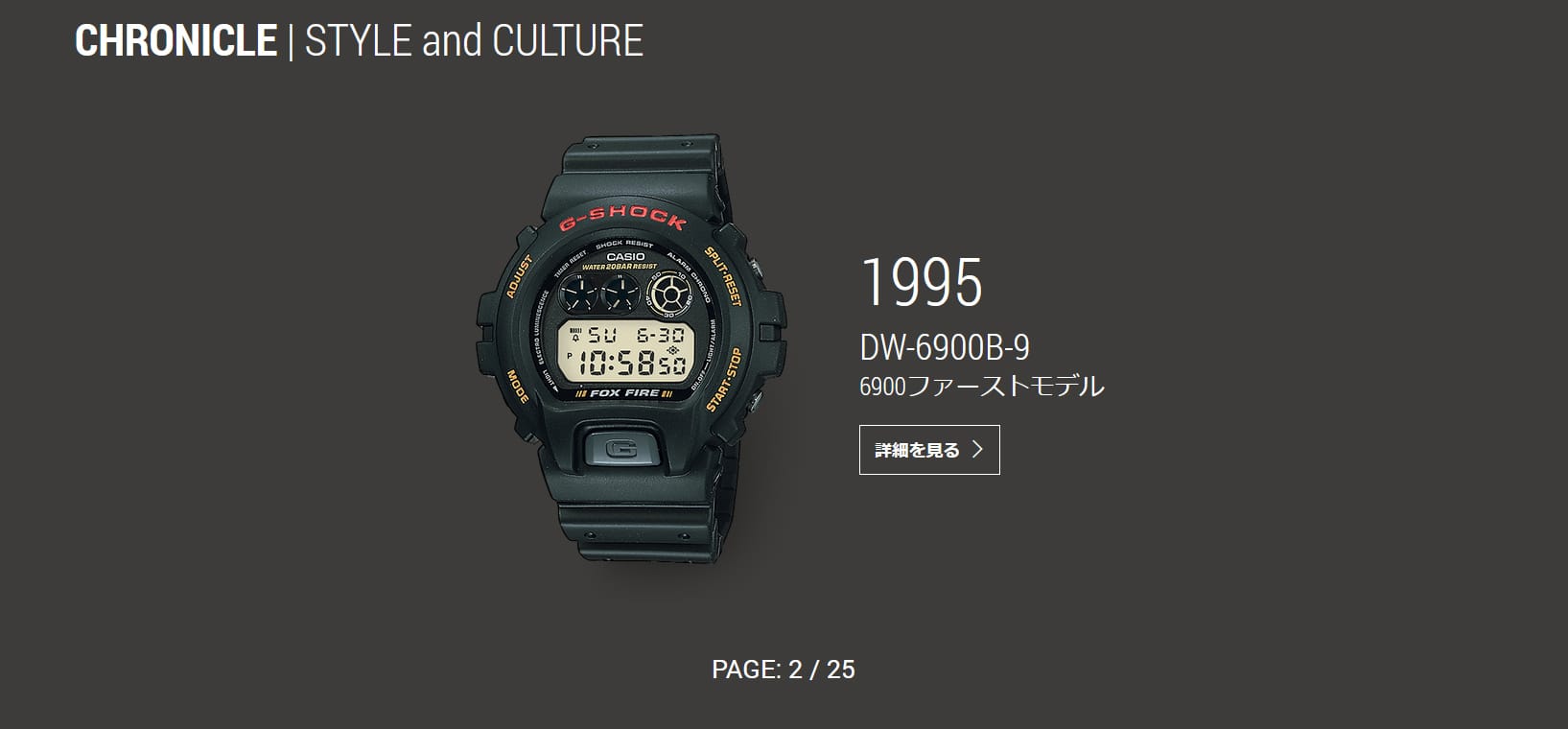
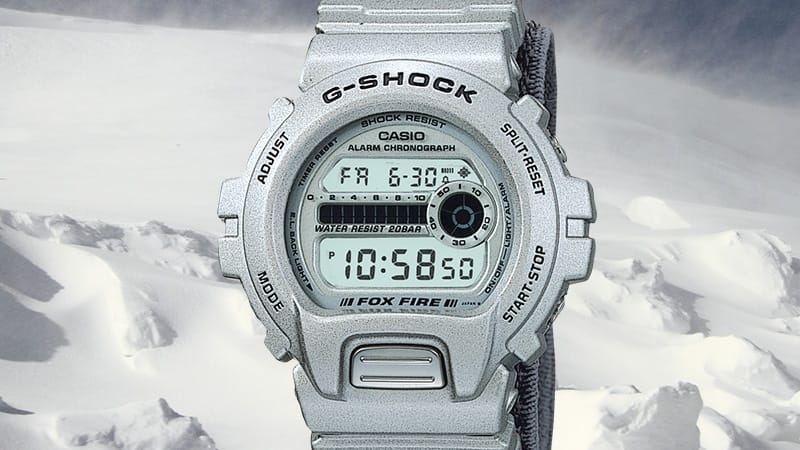
The Fox Fire label first appeared on the DW-6600, a name that likens the blue-green EL glow to the light of bioluminescent fungi, and it later turned up on the DW-5600 and the DW-6900 as well. Japan’s standard DW-6900B-9 carried Fox Fire where the international DW-6900-1V said Illuminator, and unlike the DW-6900-1V it was made in Japan.
Why the case is round
There’s an engineering argument behind the shape. According to Casio’s 6900 anniversary page, the perfect circle became the series’ design code because it was the most efficient way to arrange the parts of the shock-resistant structure: for a given perimeter, a circle encloses the largest possible area. The gain is substantial. With the same perimeter, a circle has 4/π times the area of a square, or about 27% more room inside.
Once chosen, the circle runs through the whole case. Every line on it is concentric, down to the guards that shield the side buttons, and the sloping flanks are cut as a cone, which Casio says makes the case look less bulky and keeps it from digging into the wrist. The dial is a separate plate sitting over the LCD, so it can be painted, printed and finished, and Casio notes that this widens what designers can do with the watch.
The big front button was designed for one job: the light. Casio says its shape, angle and proportions against the button guards were worked out precisely, and that the button became the emblem of the series. It’s also simply easy to find and press with gloves on.
 Image: Casio
Three eyes, several names
Casio calls the three circles the tri-graph and links them to the stopwatch and the seconds display. Fans call it the “Triple Graph”, parts of the English-language watch press the “Third Eye”, and in Japan it’s simply mitsume, “three eyes”. Casio’s own English press material has rendered the nickname as the “three-eyed watch”.
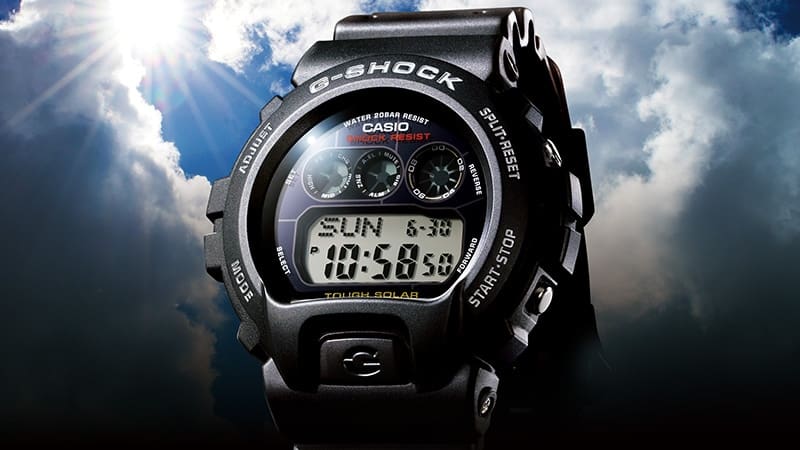
On the solar, radio-controlled GW-6900 the eyes do more work. As Fratello has pointed out, settings and measurement results appear as filled or empty segments in the circles, and only DST and RCVD are spelt out as text.
Red, yellow and the skate scene
The DW-6900H arrived in 1995 too, bringing the series’ first colour options in red, yellow and black. Casio says the yellow DW-6900H-9 overturned the assumption that a resin watch should be black and gave G-Shock an identity as a fashion item. The H series found its audience among skateboarders, “thrashers” in Casio’s word, and Gizmodo Japan adds surfers to the list.
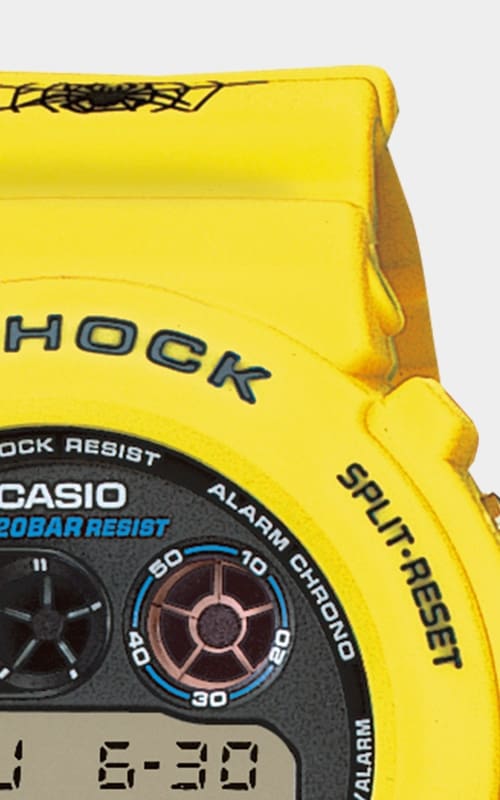
The straps carried spider and skull graphics and the line “G-SHOCK is dedicated to the soul foot in motion”. The author of the 50-gs blog, quoted by G-Central, says the series wasn’t a collaboration, that “Soul Foot” meant thrasher, and that it can be read as a forerunner of the sporty line later sold as X-TREME and now as G-LIDE.
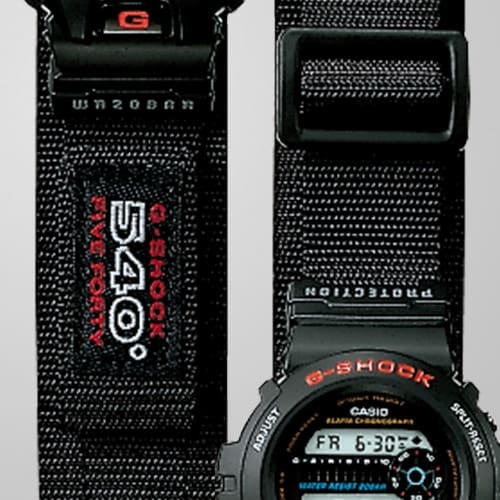
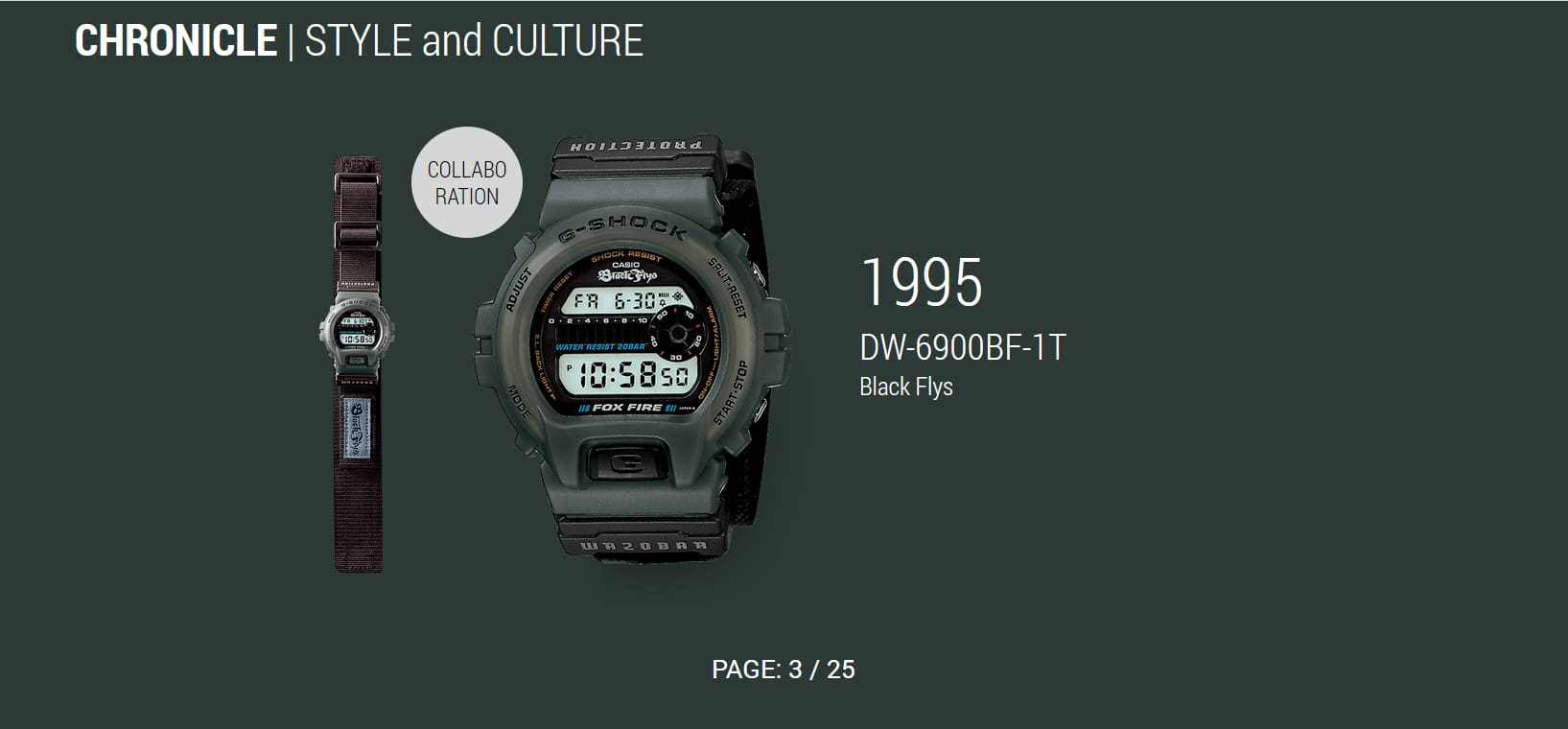
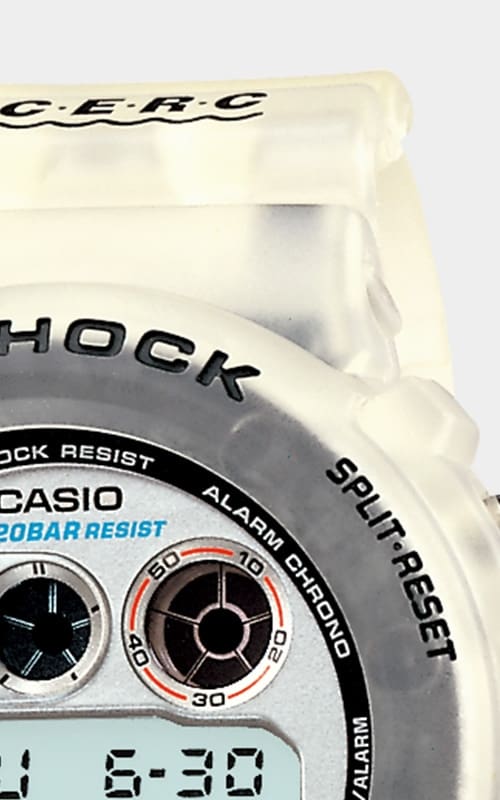
The 6900 branched out quickly. The same year brought the DW-6900BD, whose long strap fits over a jacket sleeve and was aimed at snowboarders, and the Black Flys DW-6900BF. In 1996 came the fully transparent DW-6900K and the DW-6900X, built to keep working down to −20°C.
A light that carries messages
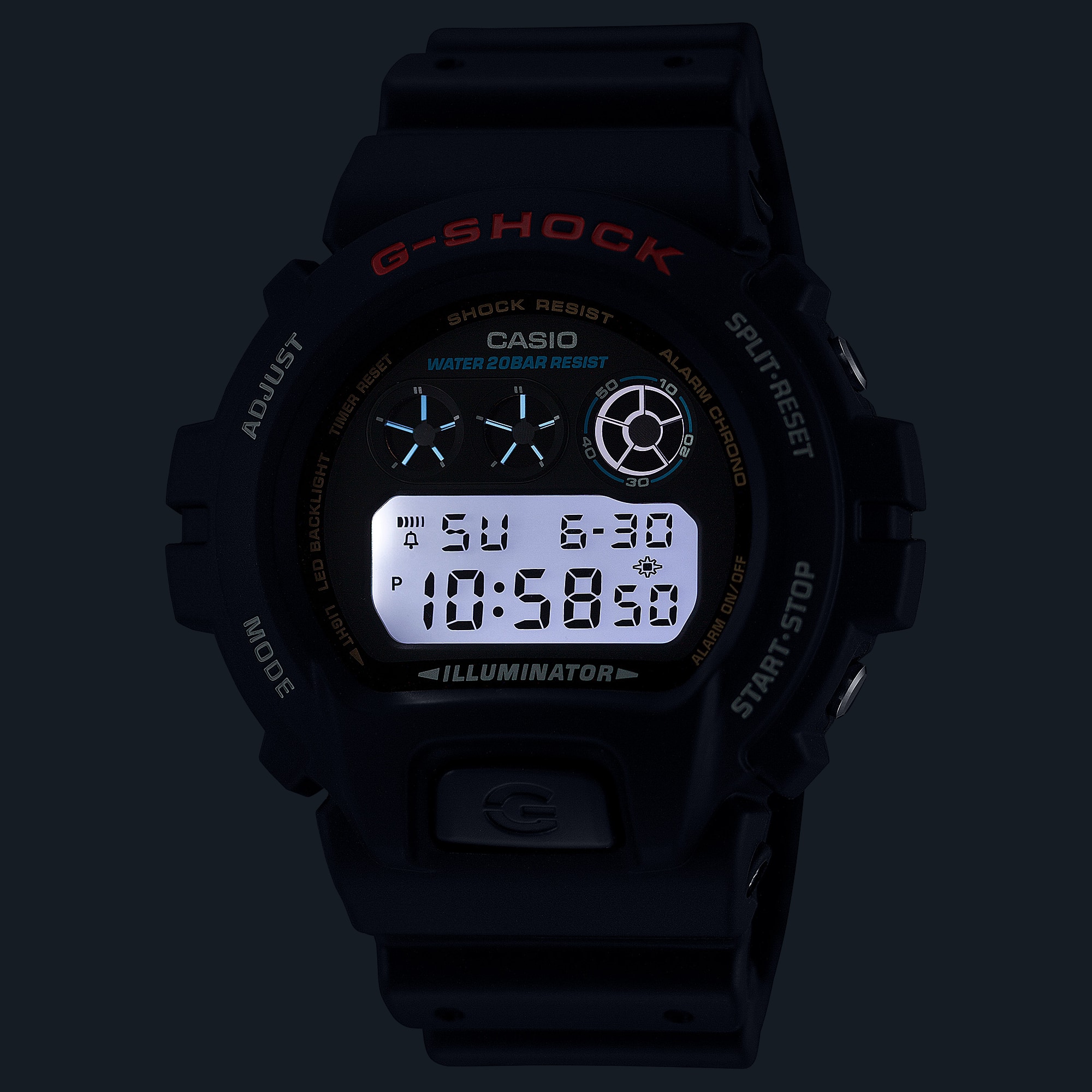
When Casio announced its 2019 ranking, it singled out the light. The DW-6600’s backlight could reveal text or a symbol, the idea caught on, and the DW-6900 became the base for collaborations and special models built around it. A graphic that only appears when someone presses the button is a neat place for a limited edition to keep its secret.
The light also works on its own. With flash alert, the backlight flashes along with the buzzer for alarms, the hourly time signal and the end of a countdown, so you can see the alert as well as hear it.
In May 2023 the base model got a technical update. Module 3529 replaced the blue-green EL with a white LED and stretched battery life to about five years, against about two years for the EL module 3230 used since 2011. Today’s DW-6900U-1 gives itself away with an “LED Backlight” label to the left of the display and 3529 on the caseback.
More than 100 collaborations
Since February 1995 the 6900 has been the base for more than 100 collaborations with brands and artists, and along with the DW-5600 it’s one of G-Shock’s favourite starting points for limited editions. The construction probably helps. A printable dial and a backlight that can show a graphic give a partner two surfaces to work with, without touching the case.
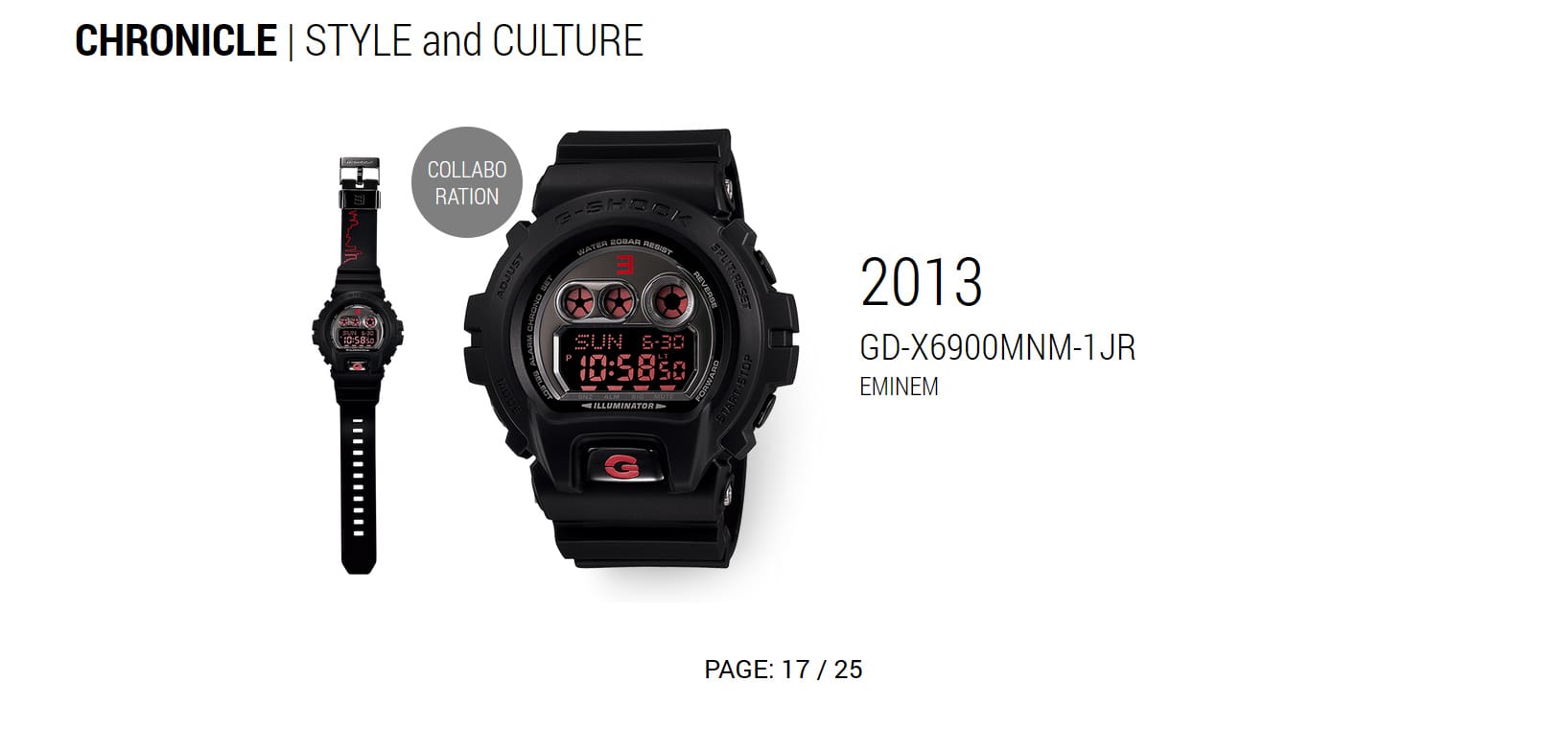
Music has supplied many of the best-known names. Eminem got his own GD-X6900MNM-1, based on the extra-large GD-X6900, in December 2013, the year of G-Shock’s 30th anniversary. John Mayer’s first watch collaboration was a DW-6900 made with Hodinkee in 2020: slate grey, inspired by Casio’s SK-5 sampling keyboard and priced at USD 180. A second followed in 2021 in the colours of Casio’s PT-80 keyboard, and a third in December 2022. In October 2023 Hodinkee released the G-Shock Ref. 6900 – Subtract by Ed Sheeran, based on the artwork of Sheeran’s album Subtract, at USD 185.
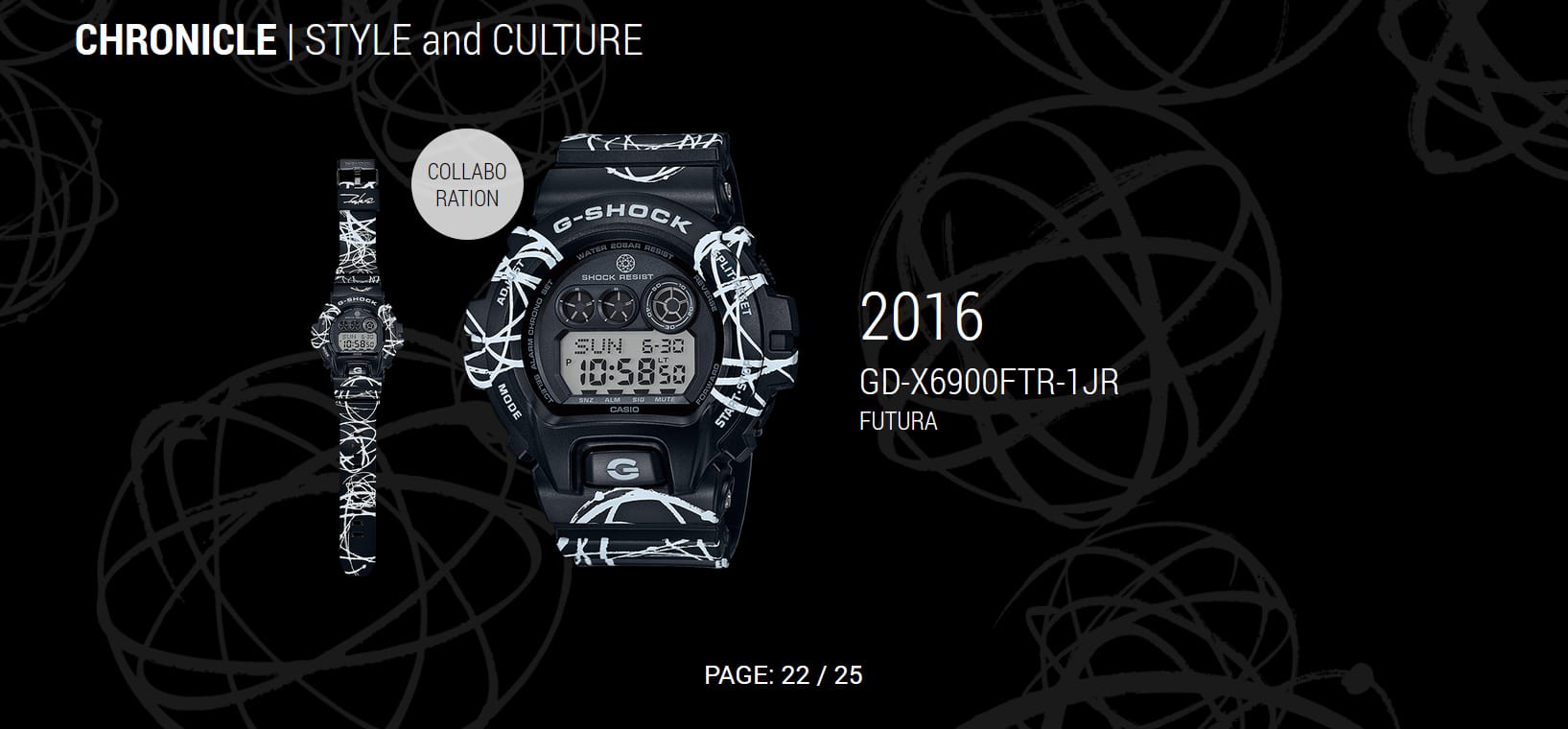
The rest of the list runs through streetwear, pop culture and art. Supreme and The North Face shared a DW-6900 in 2022; NASA, Coca-Cola and Undefeated models followed in 2023; and in 2016 the graffiti artist Futura designed a GD-X6900. Collaborations were still arriving in 2026, with Larry June’s Midnight Organic model in July and a Japan-made sushi series in October.
The most extravagant 6900s weren’t made by Casio. Jacob Arabo of Jacob & Co. reworked two of Pharrell Williams’s Bape × G-Shock DW-6900s, adding 14k yellow and white gold bezels, diamonds and, on the caseback, the caricature from the cover of Pharrell’s album In My Mind. Both went to auction in Joopiter’s “Son of a Pharaoh” sale in October 2022, each estimated at USD 17,500–27,500 and listed as “Unauthorized” because Casio hadn’t sanctioned the work. Complex reported that one sold for USD 73,750 and later appeared on Kim Kardashian’s wrist.
G-Central’s list of known wearers adds Kanye West, Usher, Chris Martin and Spike Lee.
Navy divers and a NATO stock number
The military connection goes back to the DW-6600, which has long been associated with US Navy SEALs and passed its case shape to the DW-6900. The DW-6600 was discontinued around 2010 before returning in 2023 as the DW-6640RE-1, and photos collected by G-Central show US Navy divers wearing the DW-6900 in the 2020s.
Benjamin Lowry of Watches of Espionage, who served in the US Coast Guard and worked as a commercial diver, says US military units have bought dozens of G-Shock models over the years, but only four have a NATO Stock Number (NSN): the DW-5600E-1V, DW-6600-1V, DW-6900-1V and DW-9052-1V.
Kikuo Ibe, the Casio engineer who created the G-Shock, said in a 2013 Reddit “Ask Me Anything” session that G-Shocks aren’t designed specifically for military use, though he was glad the military had taken to them. The 6900 fits that description well. The diver and the skateboarder take the same watch off the same shelf.
Solar, radio, Bluetooth and steel
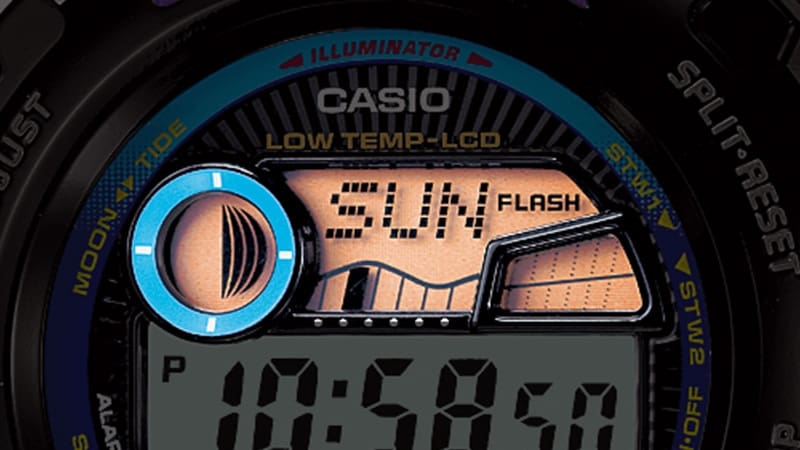
The outside of the 6900 has barely changed; the inside has moved on. In 2009 the GW-6900 added Tough Solar charging and Multi-Band 6 radio reception, which sets the time from any of six time-signal stations around the world, along with world time in 31 zones and five daily alarms, all at 63g. In 2010 the GLX-6900 targeted surfers with a tide graph and moon data, a function that still appears on watches such as the Citizen Promaster Wave Tracker regatta timer.
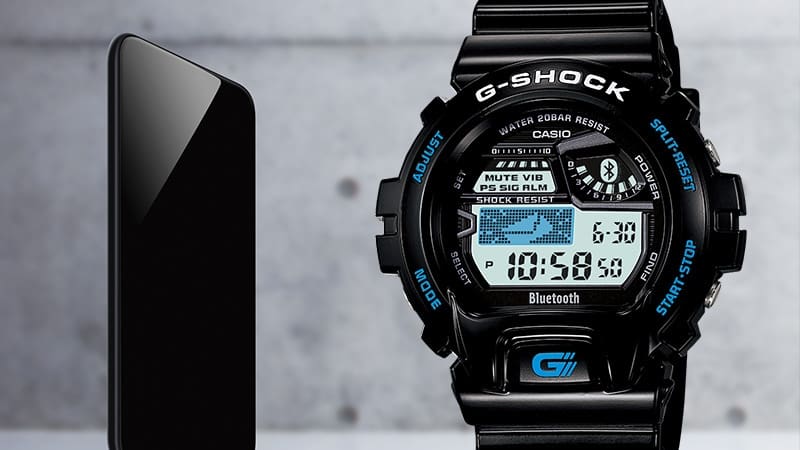
The GB-6900 of 2012 is the series’ biggest technical leap. Casio describes it as the world’s first watch with Bluetooth 4.0. It set its time from a smartphone, flagged incoming calls and emails, and ran for about two years on a button cell, assuming 12 hours of connection a day. It went on sale in Japan in March 2012, years before smartwatches became everyday objects.
In 2013 the GD-X6900FB, a version of the extra-large GD-X6900, was built to the MIL-STD-810G environmental test standard, and the GD-X line ran for about ten years on a battery. Production of the GD-X6900 had ended by May 2022; its last new model was the 2016 Futura collaboration.
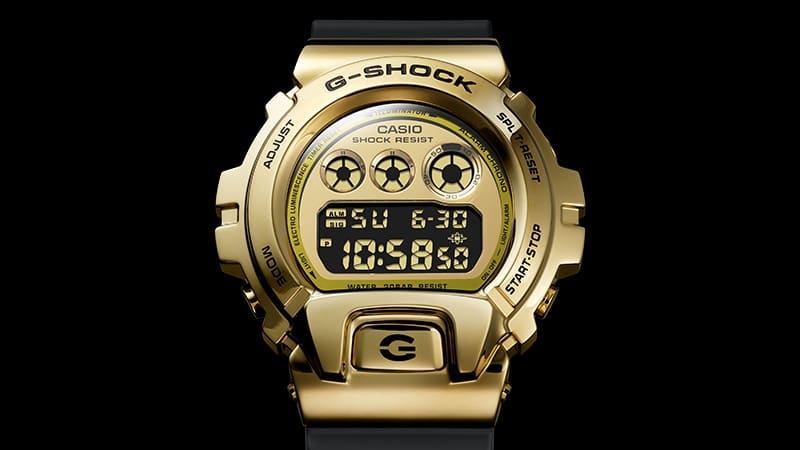
The 25th anniversary in 2020 brought the metal-covered GM-6900 with a stainless steel bezel. Casio joined the resin inner case and the steel bezel with minimal contact surfaces, keeping the two parts largely separate. Today’s GM-6900U-1 weighs 96g, 29g more than the resin DW-6900U-1.
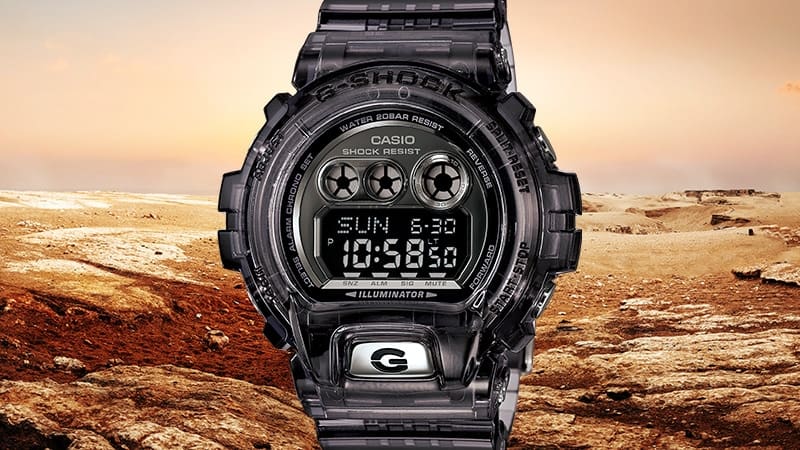
Colours and materials multiplied along the way: a stainless steel bracelet on the DW-6900RR (2002), mixed-colour moulding on the DW-6900MC (2006), a mirror dial on the DW-6900SB (2010), reptile-style embossing on the DW-6900CR (2012), the all-gold-coloured DW-6900GD (2014), a full camouflage print on the GD-X6900CM (2014), a marble print in polarising ink on the GD-X6900PM (2015) and a Cordura strap on the DW-6900BBN (2016).
How big is a 6900?
In the 1990s the DW-6900 counted as an oversized watch, and today’s base model isn’t small either: 53.2mm long, 50mm wide and 18.7mm thick, at 67g. The square DW-5600 measures 48.9 × 42.8 × 13.4mm and weighs 52g, so on paper the 6900 is 5.3mm thicker and 15g heavier.
The resin strap adjusts for wrists from 145 to 205mm. We haven’t had a DW-6900U-1 on the wrist for this article, so these are Casio’s figures, read on paper and in the official photos.

Thirty years, thirty stars
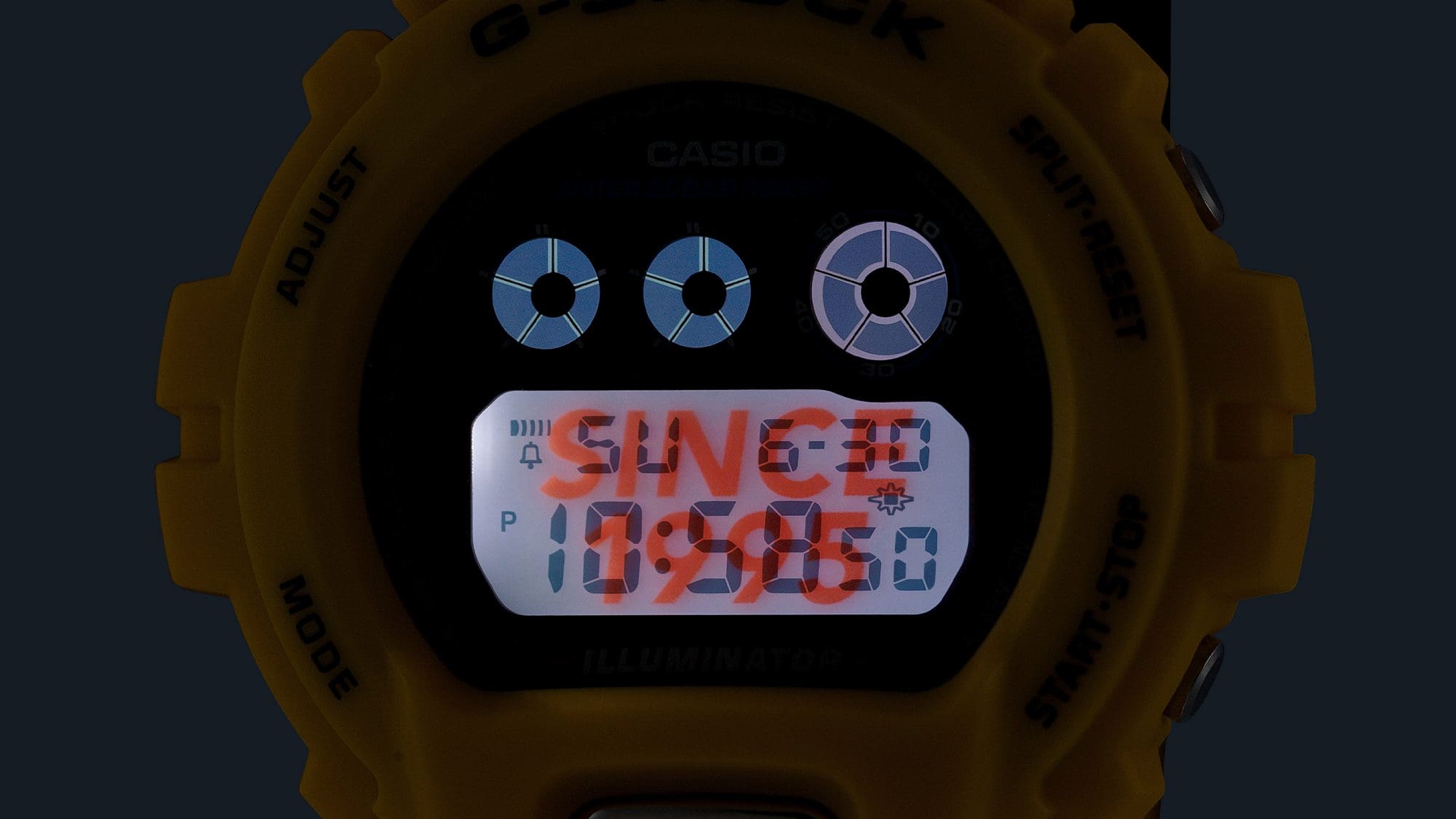
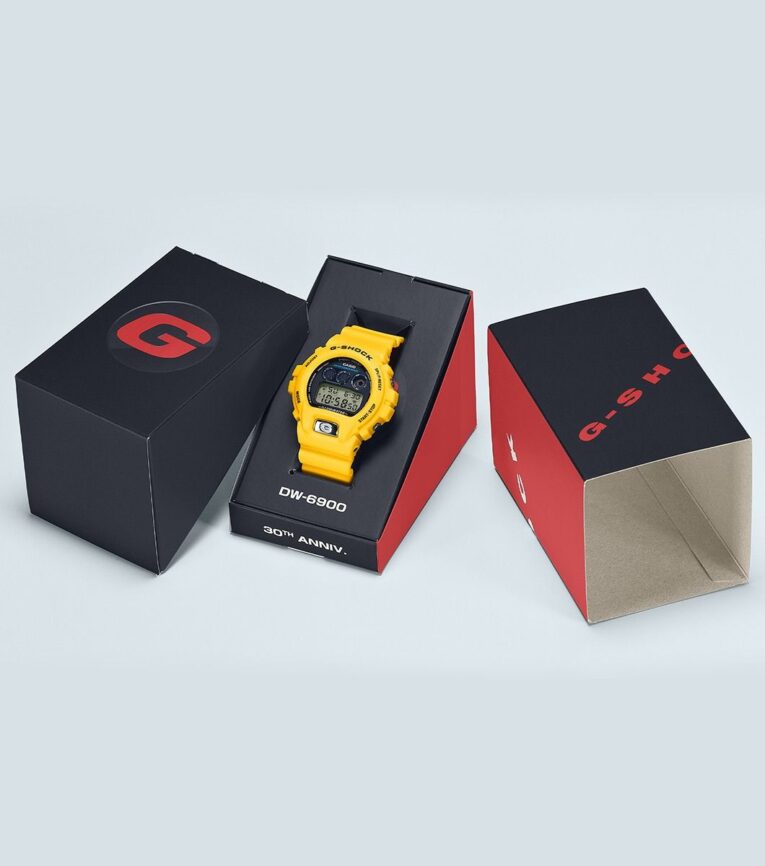
For the 30th anniversary Casio looked back rather than forward. The DW-6900TR came in black, red and yellow, the colours of the 1995 DW-6900H, and in packaging whose G motif nods to the original DW-6900H box. It went on sale in Japan on 21 February 2025 at JPY 16,500, and in the UK it was priced at GBP 99.90.
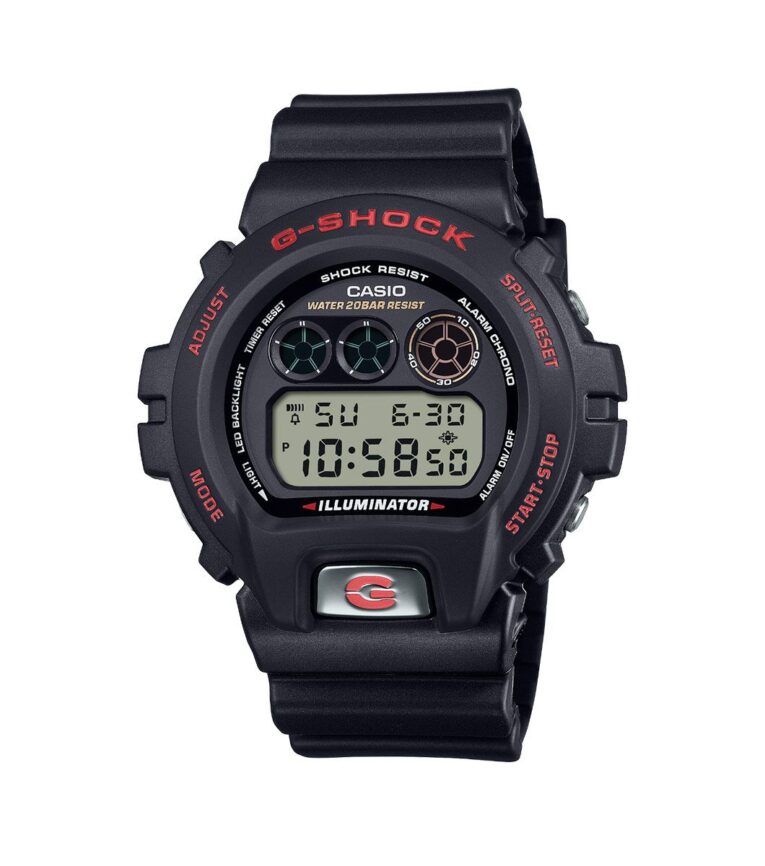
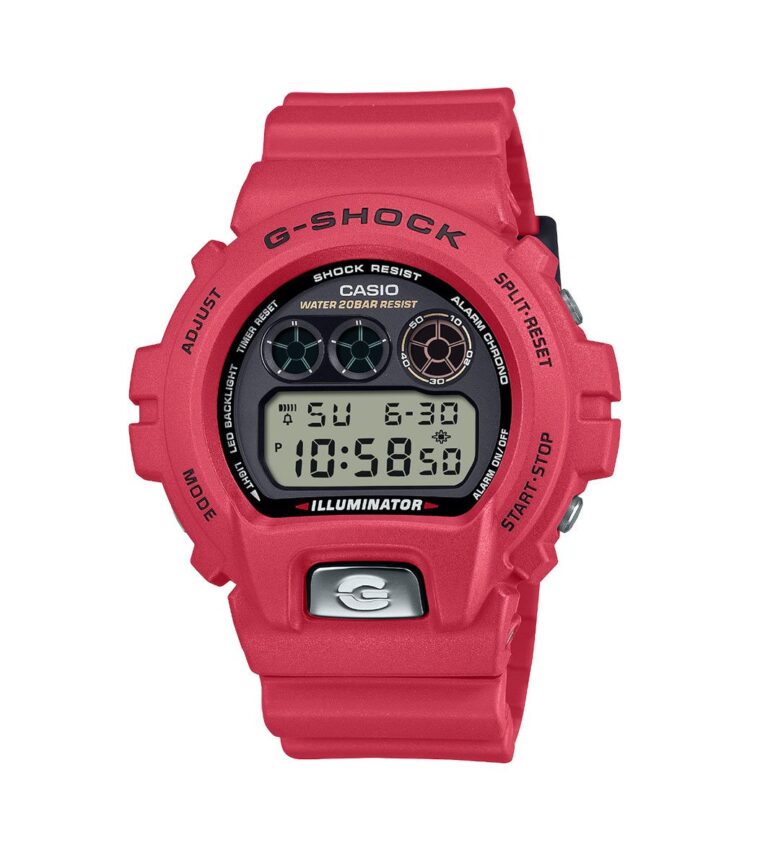
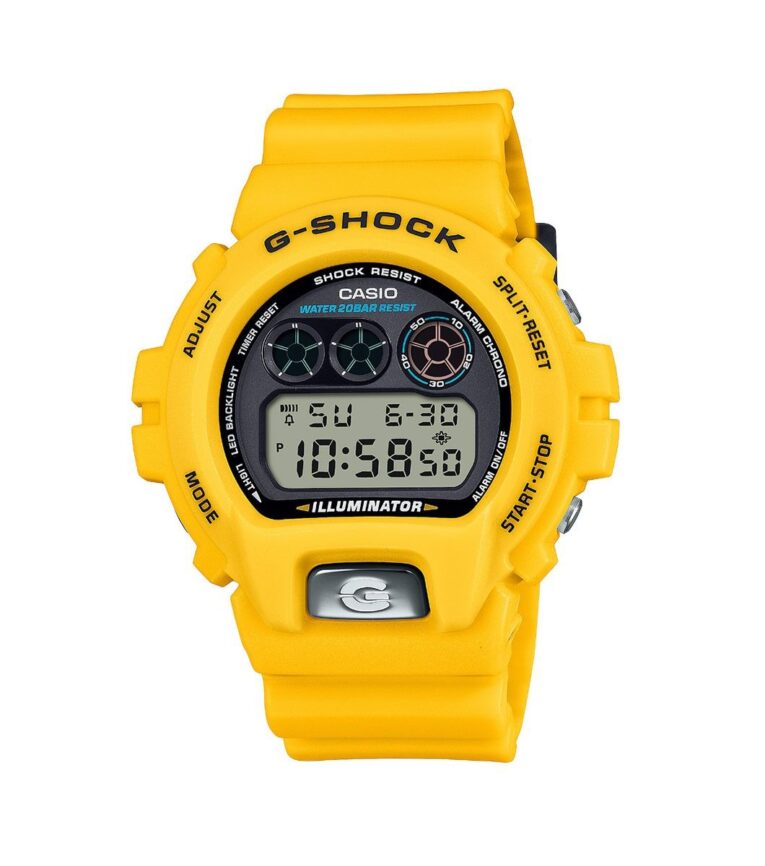
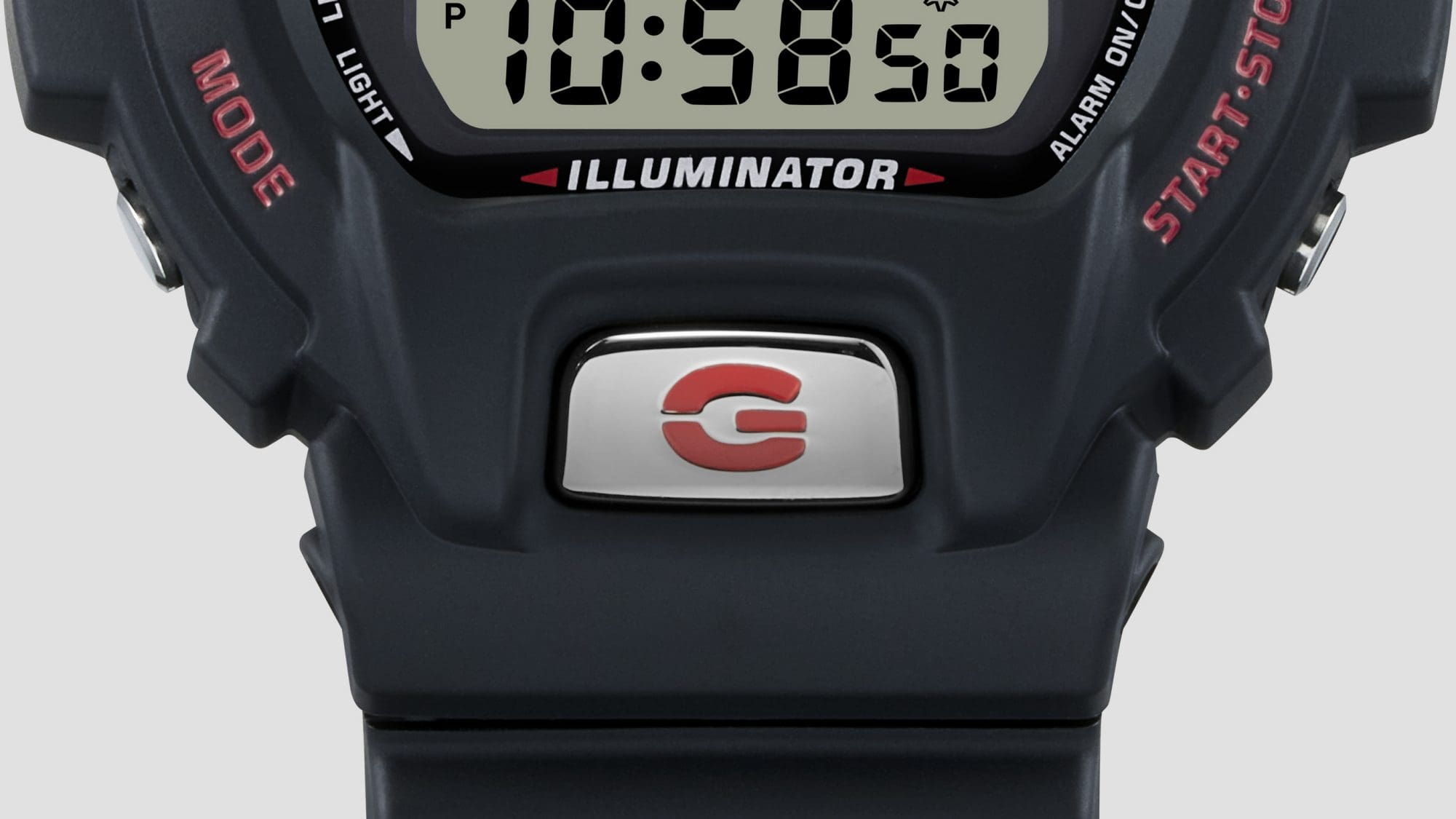
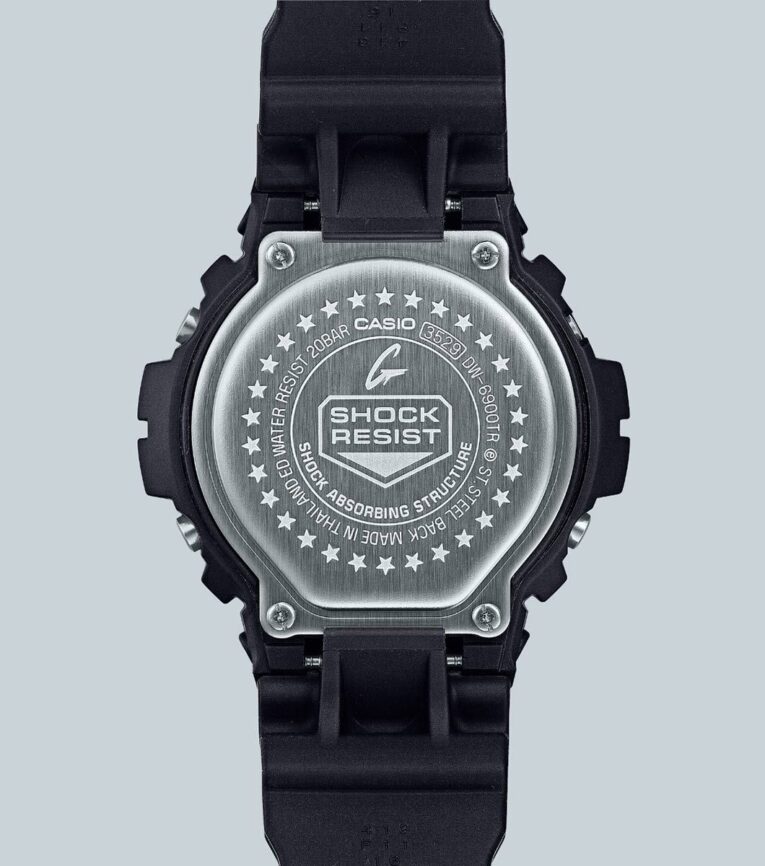
The anniversary details are small. The front button is metal, mirror-finished and etched with a G. Switch on the light and the display reads SINCE 1995, and on the caseback 30 stars surround the SHOCK RESIST logo. The bezel, strap and other resin parts use bio-based resin, and inside is the same module 3529 with LED light and about five years of battery life.
For a watch whose best quality is how little it has needed to change, a reissue in its own first colours was the obvious way to mark the date.
What today’s DW-6900U-1 does
The DW-6900U-1 keeps to the basics. The stopwatch measures to 1/100 second for the first hour and to the second after that, up to 24 hours, with split times and 1st–2nd place times. The countdown timer runs for up to 24 hours with auto-repeat. There’s a multi-function alarm, an hourly time signal and a full auto-calendar to 2099, along with ±15 seconds a month of accuracy and 200m of water resistance.
There’s no world time and no radio time-setting. For those you need the GW-6900, which adds both along with solar charging. The full current range is on Casio UK’s 6900 Series page, and the square side of the family has gone as far as the 20-piece sapphire MRG-D5000.
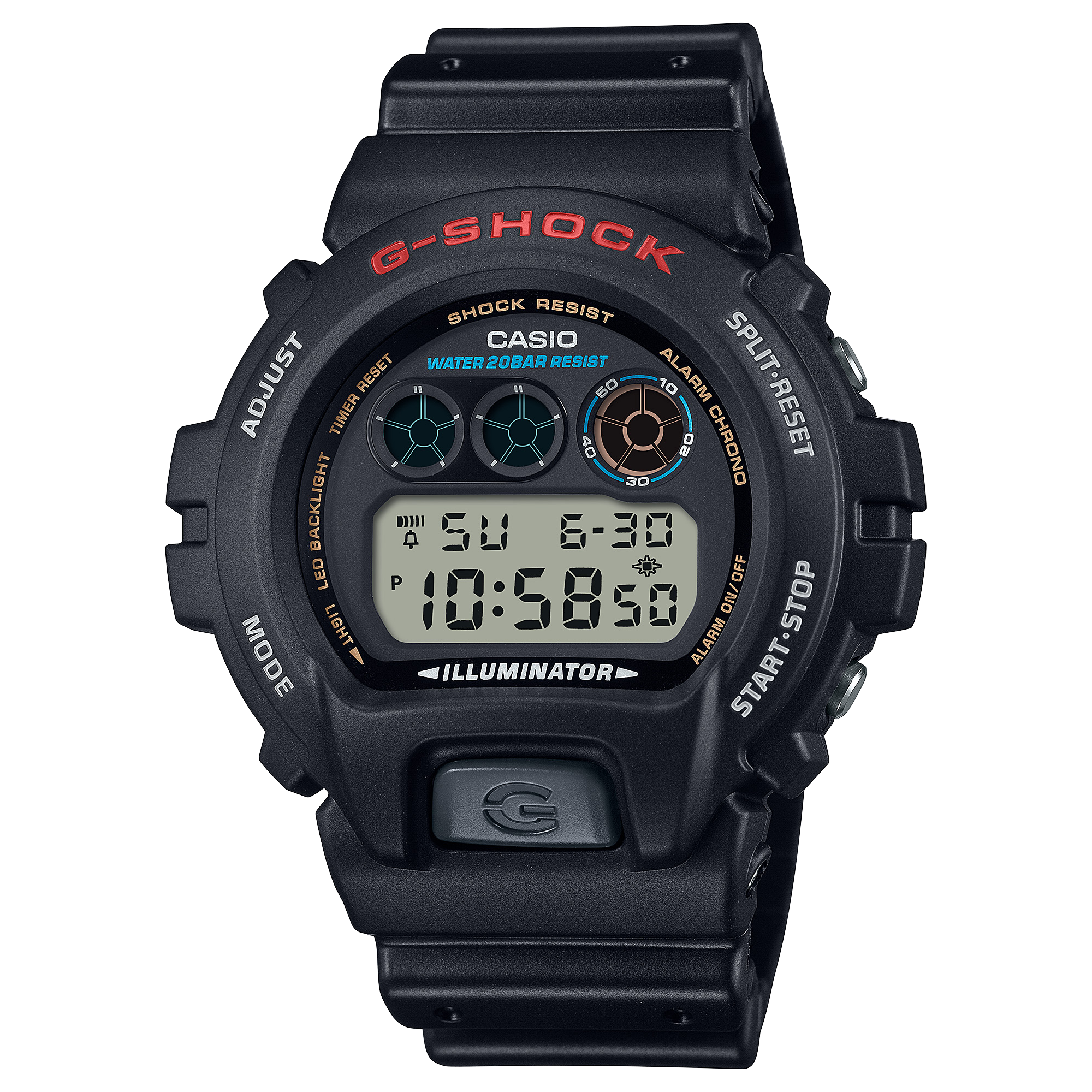
Specifications – G-Shock DW-6900U-1
- Reference(s)
- DW-6900U-1ER (black, UK)
- Case
- Resin case and bezel; 53.2 × 50 × 18.7mm (L × W × H); 67g
- Crystal
- Mineral glass
- Water resistance
- 200m (20 bar)
- Dial
- Digital LCD with three circular graph displays above the main display; “LED Backlight” label to the left of the display
- Movement
- Casio module 3529, quartz; accuracy ±15 seconds per month
- Power reserve
- CR2016 battery, approx. 5 years
- Functions
- Hours, minutes, seconds, pm, month, date, day, 12/24-hour format, full auto-calendar to 2099, 1/100-second stopwatch up to 24h with split and 1st–2nd place times, 24h countdown timer with auto-repeat, multi-function alarm, hourly time signal, LED backlight (Super Illuminator) with afterglow and flash alert
- Strap/bracelet
- Resin strap, fits 145–205mm wrists
- Availability
- Current collection, LED version since May 2023; Casio UK online store and retailers
The G-Shock story starts with a square, but in Japan it was the round one that shipped in the greatest numbers. A circle, three eyes and one button. Thirty years on, that’s still enough.