Explained
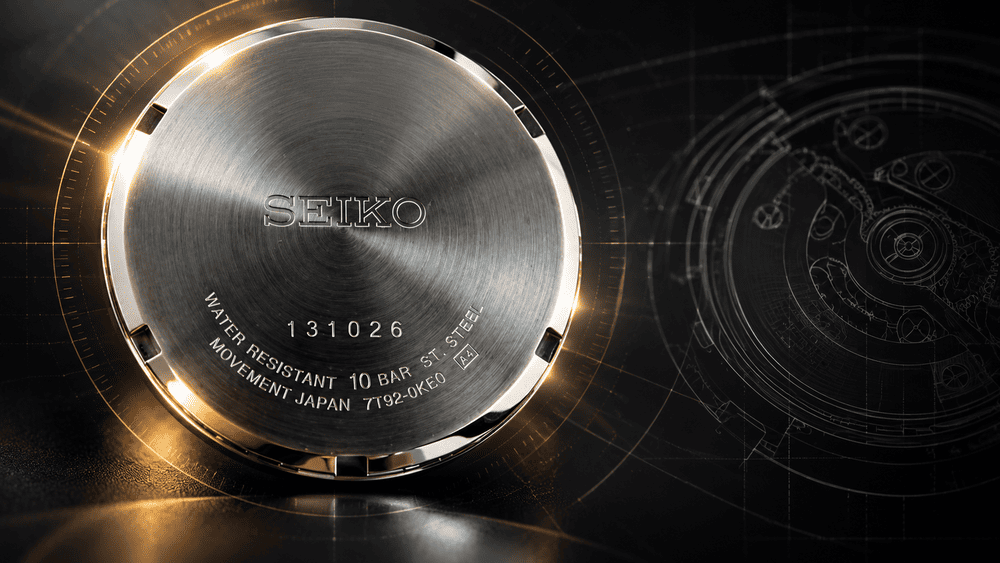
Six characters on the back of most Seikos give the month and year of manufacture, though the year repeats every decade; our calculator shows which ones fit.
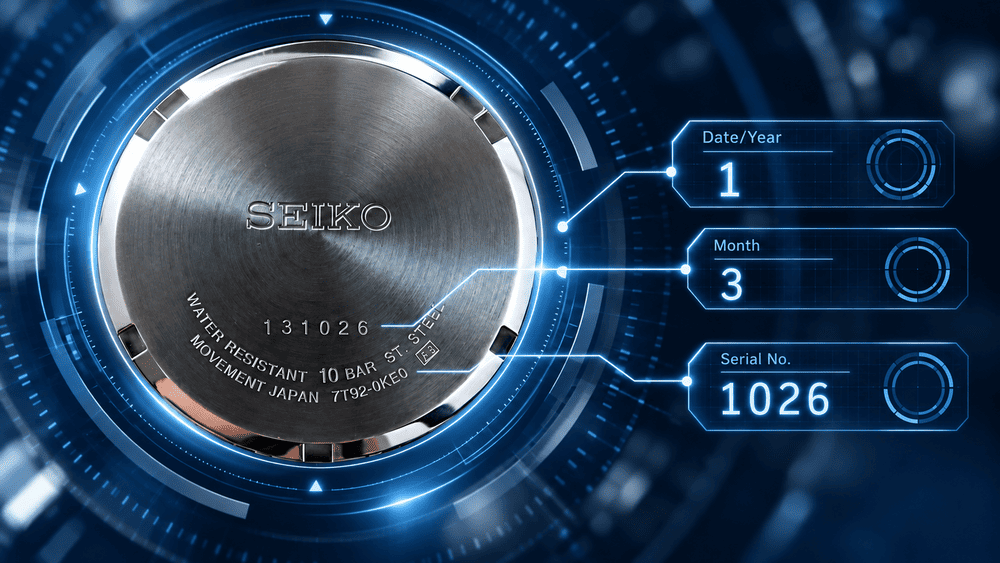
Seiko has stamped a production date on the back of its watches since the mid-1960s. It’s a genuinely useful habit, with one catch: the date leaves out the decade.
A serial such as 4D8001 tells you December of a year ending in 4. Whether that means 1974, 1984 or 1994 is left to you, and that’s where the guesswork starts. The calculator further down lists every year a serial can mean, then strikes out the years that the calibre and the markings on your watch rule out.
Where the serial sits on the caseback
Turn the watch over. On a solid steel or titanium caseback the serial is the run of six characters stamped in a straight line, while most of the other text follows the curve of the rim. On display backs it’s often printed faintly on the glass or engraved on the caseback rim, so tilt the watch towards a light. Some early-1960s Seikos carry it on the inside of the caseback.
The number people most often mistake for the serial is the case number: four characters, a dash and four more, such as 6309-7040. The first group is the calibre, the movement inside, and Seiko’s instruction library is sorted by exactly that code, which it tells owners to read off the caseback. The second group is the case design code, and it only means something together with the calibre: a 5740-8000 and a 6105-8000 have completely different cases. The code printed at the bottom of the dial identifies the dial, so on a Seiko 5 with a 6309-8840 caseback it can read 6309-820N.
werkmania · Seiko caseback guide
What a Seiko caseback tells you
- 1Water wording: “Water Proof” on older cases, “Water Resist” from around 1970–71.
- 2Case material: stainless steel, or a code such as SGP for gold plating.
- 3Case number: calibre (7005) before the dash, case design code (8062) after it.
- 4Crest: on vintage pieces, the mark of the company that made the watch, Daini Seikosha or Suwa Seikosha.
- 5Serial: year digit, month, running number. 652290 reads May, year ending in 6.
- 6Case maker code: country plus a letter, usually read as the case maker.
- 7Construction mark: a boxed code on later casebacks that tells a watchmaker how the case is built.
Schematic, not to scale. The case number, serial and case maker code follow a 7005-8062 documented by Plus9Time; the crest is a placeholder shape. Amber marks the two codes you need to date the watch.
Reading the six characters
The first character is the last digit of the year. The second is the month: 1 to 9 for January to September, 0 for October, N for November and D for December. The 0 is a zero rather than the letter O, which matters when a worn stamp leaves you guessing. The last four digits are a running number within that month.
Plus9Time uses a 7005-8062 with the serial 652290 as its example: May of a year ending in 6, which it dates to May 1976, running number 2290. How Seiko handed out those running numbers across models and production lines isn’t publicly documented, so read the number as an identifier and leave it there. Quartzimodo notes that collectors generally take 0000 as the first watch of the month.
Before 1966 Seiko used seven characters in a similar layout, and the longer format hung on until 1969, so late-1960s watches can carry either. Most seven-character serials read year, month, running number, but Plus9Time has found examples that seem to put the month first.
Why the decade goes missing
One digit for the year means every serial repeats every ten years. The way out is the calibre. Most Seiko movements stayed in production for less than a decade, so once you know when a calibre was made, usually only one year fits. The 7002 diver calibre is the easy case. It ran from about 1988 to 1996, so a 7002 serial starting with 5 can only be 1995.
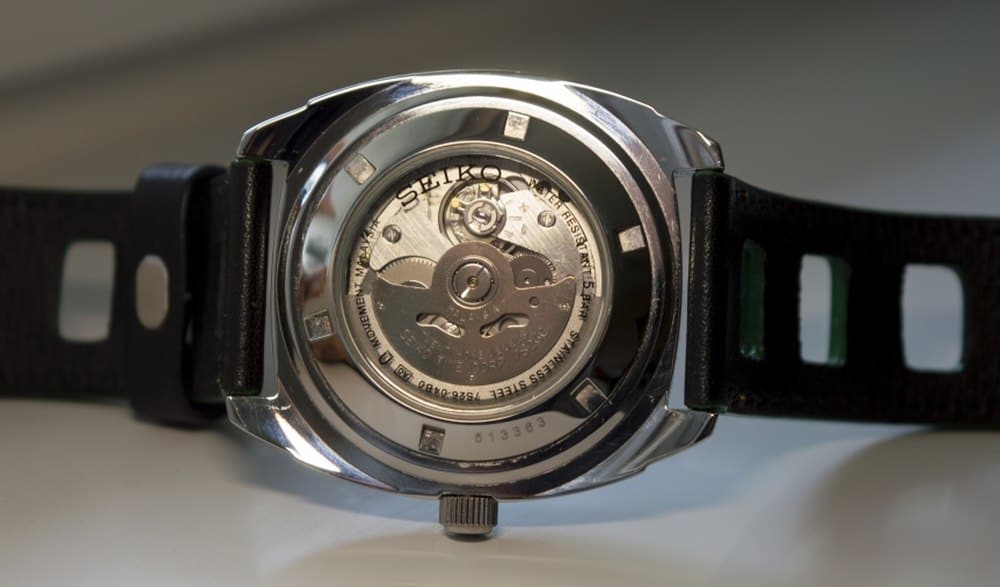
Long-running calibres are harder. The 7T32 alarm chronograph was made from about 1988 to 2002, so a serial starting 1N could be November 1991 or November 2001. The 7S26 automatic arrived in 1996 and stayed for well over a decade in three revisions: 7S26A until 2006, 7S26B from late 2006 and 7S26C from late 2011. The revision letter is engraved on the rotor, so a display back can settle the decade without opening anything.
Older calculators handled this by guessing. Quartzimodo pointed out in 2008 that the original Jayhawk calculator dated any 7S26 with a serial starting 7 to 1997, even when the watch was plainly a 2007 piece. Ours takes the other route: when two years fit, it shows both and tells you what would separate them.
werkmania · Seiko serial number calculator
When was it made? Seiko serial number decoder
Type the serial from the caseback and, if you can, the calibre before the dash. The calculator lists every year the serial can mean, then strikes out the years that the calibre and your clues rule out.
The calculator didn’t start. If this message stays, the browser or the website has blocked its script.
The calibre table behind the calculator holds more than 700 movements, most of them from the WatchSleuth Seiko Date Finder community database, with the calibres named here checked against Plus9Time, Quartzimodo and Watcharama. The years are approximate. Where an older calibre's end year isn't known, the calculator treats its first decade as likely and keeps the later years as possible. If yours isn't listed, the clue buttons still work.
Clues that settle the year
When the calibre leaves two candidates, the watch usually gives away which one is right. These are the checks behind the clue buttons.
- Water Proof or Water Resist. Seiko changed the caseback wording from “Water Proof” to “Water Resist” around 1970, after legislation changed in the US market, and by 1971 almost every model had switched.
- Technology dates. Seiko's own history puts the Quartz Astron in 1969, the six-digit LCD watch in 1973, A.G.S. (later renamed Kinetic) in 1988, Spring Drive in 1999 and the Astron GPS Solar in 2012. No Kinetic predates 1988.
- Model numbers. Seiko model numbers have begun with S since the mid-1980s, and the new scheme that started in March 2026 begins with H. Within one calibre the letters also move on over time: the first 7T32 models were SDW, the last SDWG.
- Battery-change scales. Many quartz divers have a ring of years around the caseback, punched at the first suggested battery change. The mark sits roughly one battery life after production: a 7C43 diver made in 1992 carries its punch at 1995. Seiko service centres often stamp later changes as B plus year and month, so B0104 is April 2001.
- Catalogues. With a candidate year in hand, a period catalogue shows what Seiko was selling; Plus9Time keeps a large collection of scans.
When the serial isn't a date
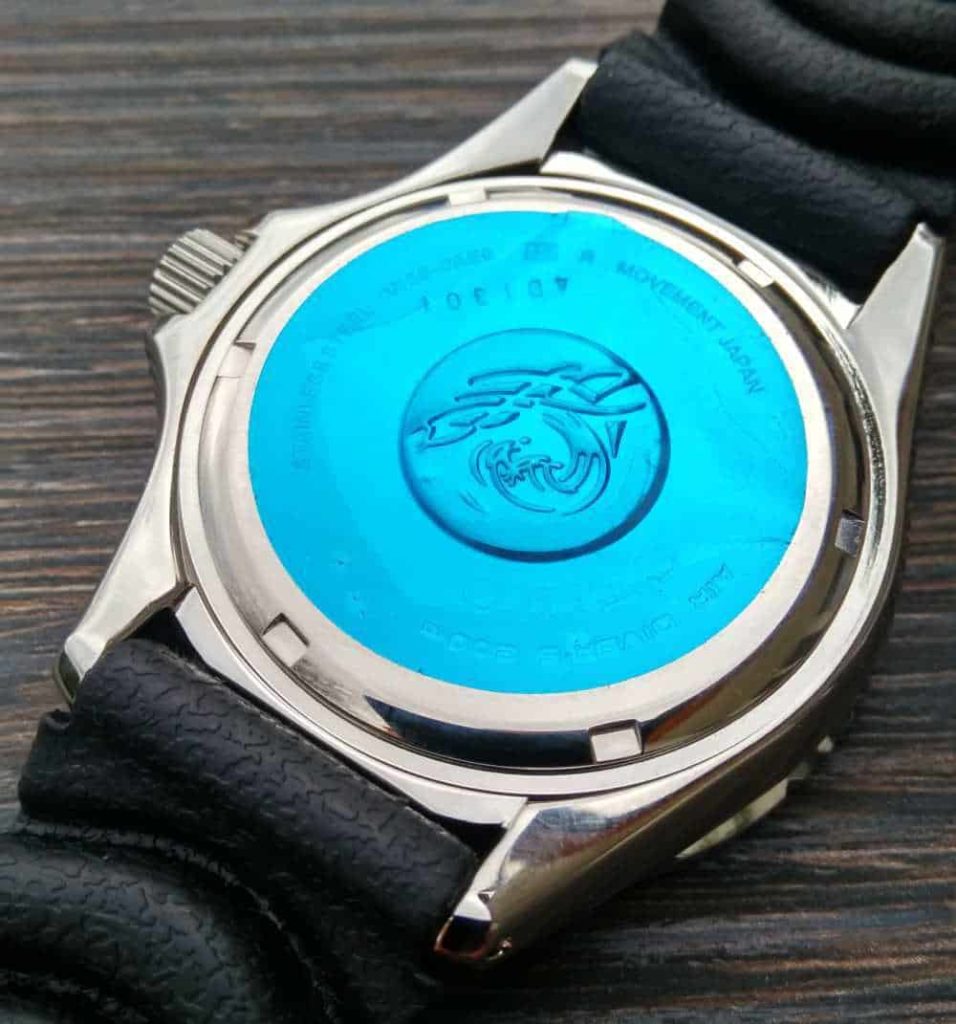
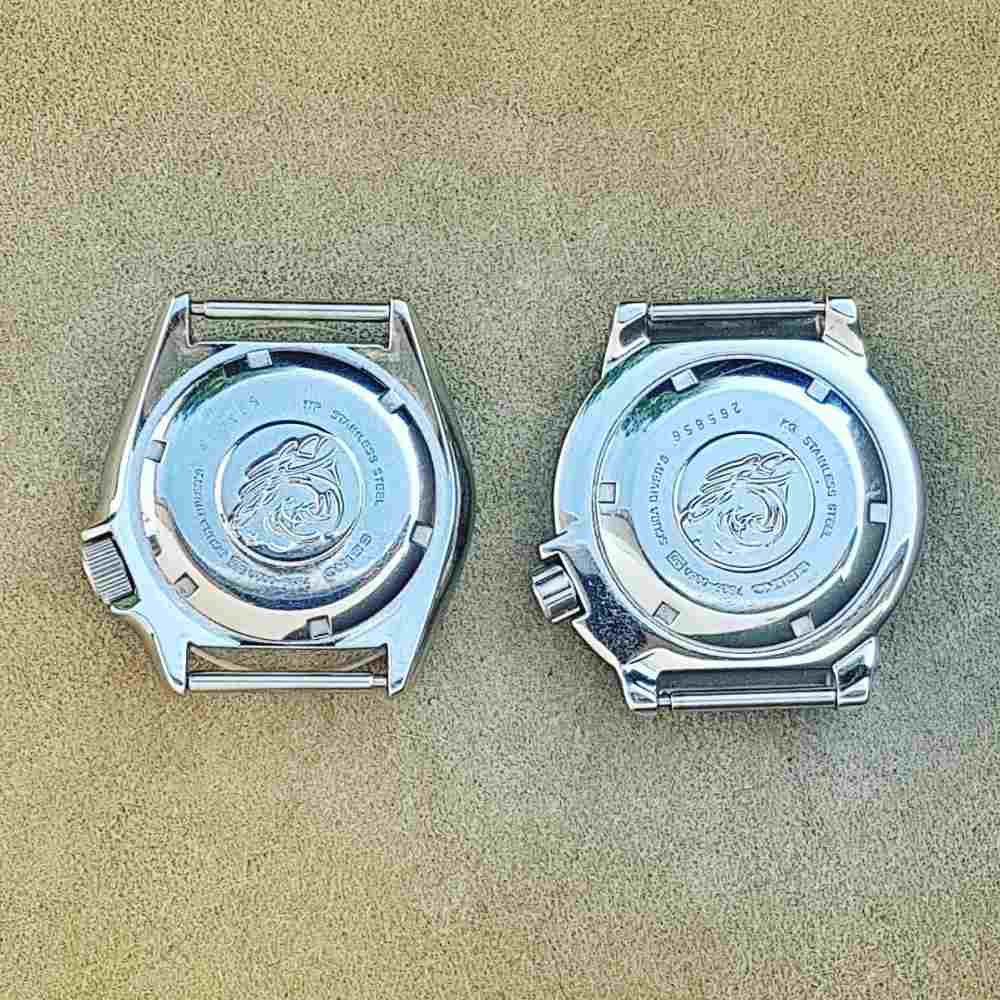
Three cases break the rule. Seiko 5 Sports models from the 2019 relaunch, recognisable by the new 5 logo on the dial, still carry six digits, but they no longer follow the year-and-month layout. Plus9Time found 173621 on an SRPD55K1 bought in 2020, which would otherwise read as July of a year ending in 1. Limited editions numbered on the caseback, in the 123/300 style, usually have no serial at all. And a caseback replaced during a service can come back blank.
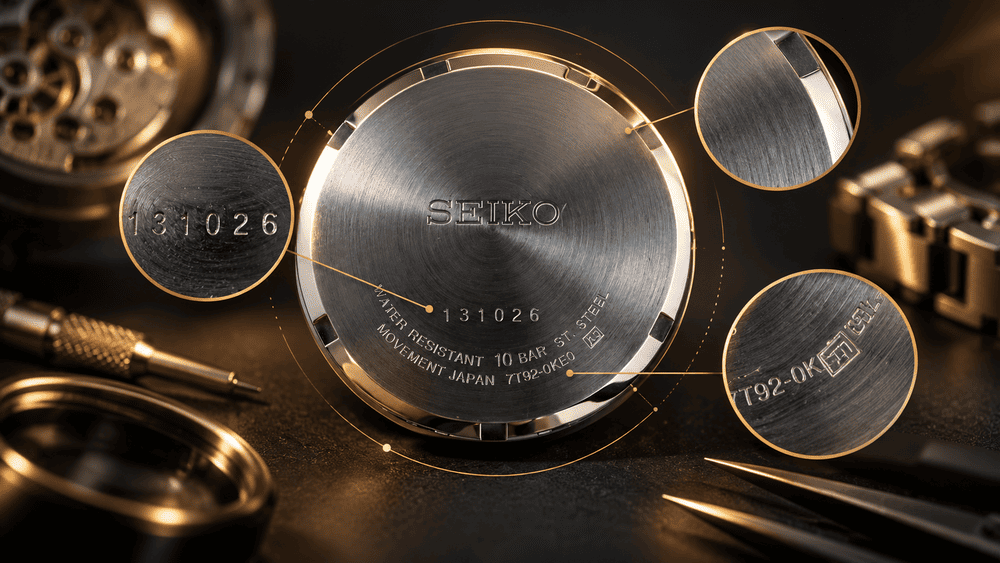
The serial also dates only the caseback it's stamped on. Swapped casebacks, dials and movements are common on older Seikos, and a plausible serial proves nothing about authenticity. Used the other way round, the date is a good test. A 7002 caseback with a serial starting 7 can't be right: the calibre didn't exist in 1987 and was gone by 1997.
We couldn't find a Seiko guide to the date code. What collectors know comes from comparing casebacks with catalogues, and from a 1969 issue of Let's Go Suwa, the in-house magazine of the Suwa Seikosha factory, which set out what each marking meant; Plus9Time has published the page with an English translation. So when the calculator gives you two years, take it at its word and open a catalogue from each.
Questions about Seiko serial numbers
How do I find out when my Seiko was made?
Read the serial on the caseback: the first digit is the last digit of the year and the second character is the month. Then use the calibre in the case number, such as 6309 in 6309-7040, to work out the decade.
What do N and D mean in a Seiko serial number?
They are months. Seiko uses 1 to 9 for January to September, 0 for October, N for November and D for December.
Why doesn't my Seiko 5 Sports serial give a sensible date?
Seiko 5 Sports models from the 2019 relaunch, with the new 5 logo, use six digits that don't follow the year-and-month layout. Their serial can't be used to date the watch.
Does a Seiko serial number prove the watch is genuine?
No. It dates the caseback it's stamped on, and casebacks, dials and movements are often swapped on older watches.
Where is the calibre number on a Seiko?
On the caseback, as the four characters before the dash in the case number. Seiko sorts its instruction manuals by that calibre code.